On Wednesday, November 25, 2026, the Church honors St. Catherine of Alexandria, virgin and martyr. In the traditional calendar of the 1962 Missal her day is a third-class feast, and in the current Roman calendar it is an optional memorial. For centuries few saints were more loved in Christendom. In parts of France her feast was once even kept as a holy day of obligation. She is the young woman who, in the words of the Psalm the Church sings at her Mass, “spoke of thy testimonies before kings” and “was not ashamed” (Psalm 118:46, Douay-Rheims).
A Noble Daughter of Alexandria
Catherine’s story comes to us through her ancient Acts, preserved in Greek, Latin, and Arabic. Tradition tells us she was born into a noble family in Alexandria, the great Egyptian city of learning, and that she was remarkably gifted in philosophy and the sciences. Converted to Christ as a young woman, she is said to have given herself to Him as His bride, refusing every earthly suitor.
When the emperor came to Alexandria and ordered sacrifices to the gods, the young Catherine, only about eighteen years old, went to him in person, rebuked his cruelty toward Christians, and tried to show him the folly of idol worship. The older Greek Acts name the persecutor as Maximinus Daia; the Roman Martyrology and much of the Western tradition name Maxentius. Either way, the setting is the last great persecution in the first years of the fourth century, and her martyrdom is traditionally placed around the year 305.
The Debate with the Philosophers
Unable to match her learning, the emperor summoned the finest scholars he could find to argue her into apostasy. As the 1911 Catholic Encyclopedia recounts, “she emerged from the debate victorious. Several of her adversaries, conquered by her eloquence, declared themselves Christians and were at once put to death.” The tradition continues that the empress and Porphyry, the captain of the guard, visited her in prison, were converted, and were martyred in their turn.
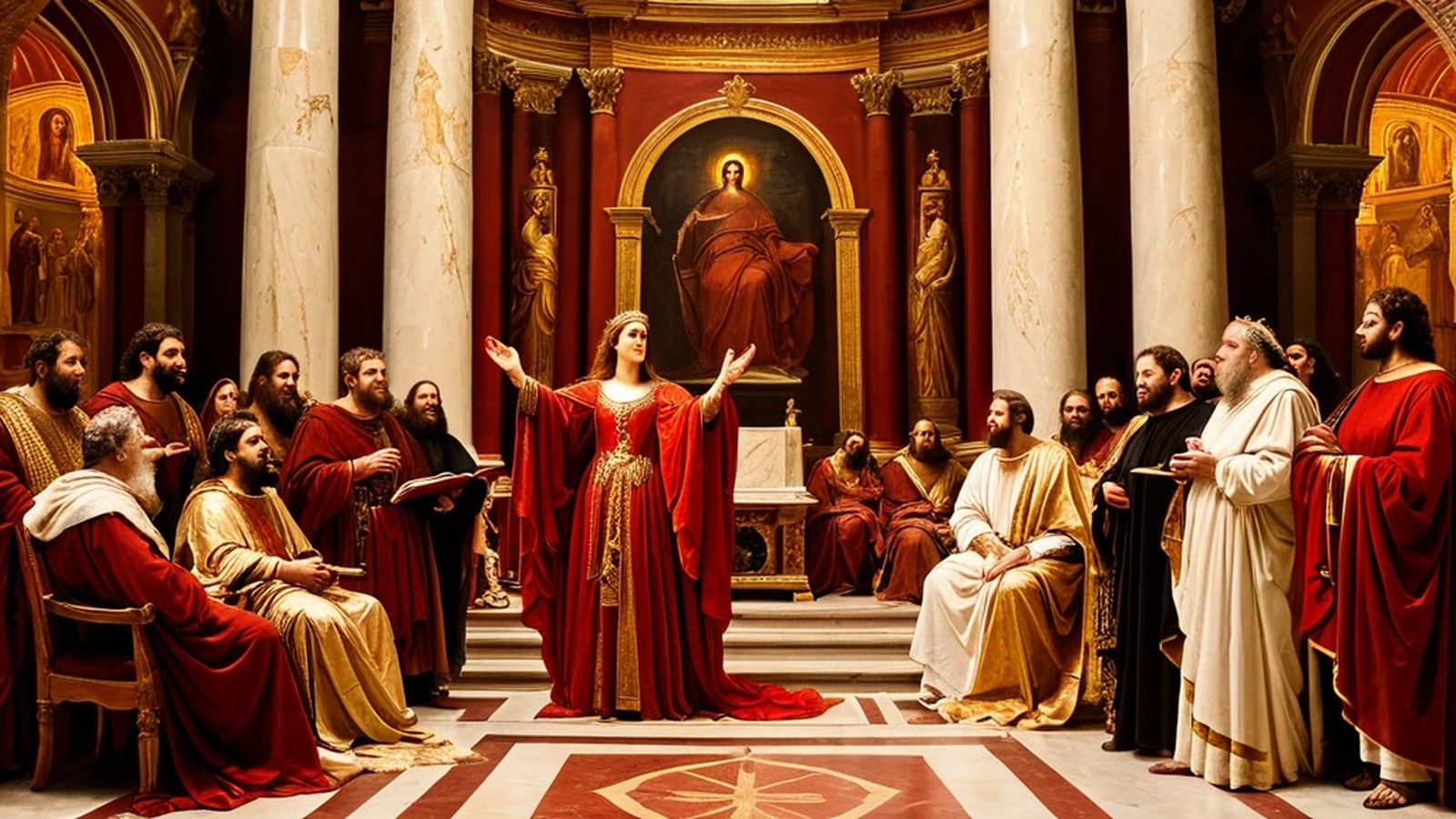
Here is the heart of why the Church has always prized her memory. Catherine shows that the faith is not afraid of the mind. The Catechism teaches, quoting the First Vatican Council, that “though faith is above reason, there can never be any real discrepancy between faith and reason,” since “the same God who reveals mysteries and infuses faith has bestowed the light of reason on the human mind” (CCC 159). St. Peter asks every Christian to be “ready always to satisfy every one that asketh you a reason of that hope which is in you” (1 Peter 3:15). Catherine did exactly that, at the cost of her life.
The Wheel and the Sword
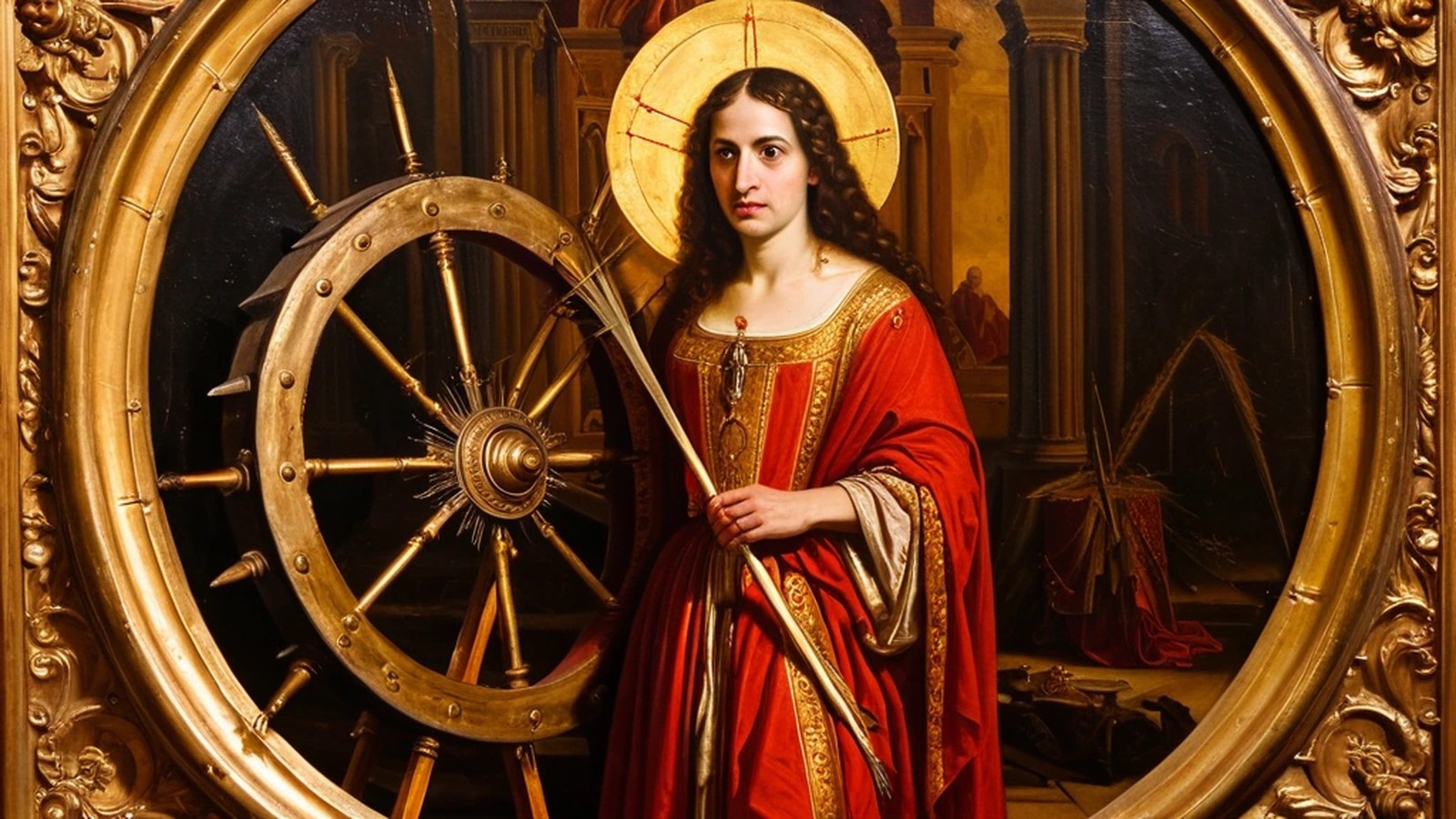
Enraged, the emperor had Catherine scourged and imprisoned, and then condemned her to be torn apart on a wheel studded with spikes. At her touch, the tradition says, the engine of torture shattered. The “Catherine wheel” became her emblem in art, and even gave its name to a spinning firework. Finally she was beheaded with the sword, giving the supreme witness. “Martyrdom,” the Catechism says, “is the supreme witness given to the truth of the faith: it means bearing witness even unto death” (CCC 2473).
Carried by Angels to Mount Sinai
The most beautiful part of the tradition concerns what happened next. Her Acts say that angels took up her body and carried it to the summit of Mount Sinai, the mountain where God gave the Law to Moses. Centuries later, the monks of Sinai venerated her relics in the great fortified monastery built at the foot of the mountain by the Emperor Justinian in the sixth century. Originally dedicated to the Transfiguration, it came to be known simply as St. Catherine’s Monastery. It is among the oldest continuously inhabited Christian monasteries in the world.

Holy Helper, Voice to St. Joan, Patroness of Scholars
Together with St. Margaret and St. Barbara, Catherine is numbered among the Fourteen Holy Helpers, the saints whose intercession was invoked with special confidence in the plague-ridden late Middle Ages. In the fifteenth century St. Joan of Arc testified at her trial that the voices which guided her were those of St. Michael the Archangel, St. Margaret, and St. Catherine.
Because she “closed the mouths of sophists,” as the old Catholic Encyclopedia puts it, Catherine became the patroness of philosophers, theologians, apologists, preachers, students, and young women, and of wheelwrights. Scholars once asked her help before studying, writing, or preaching. Like St. Cecilia, whom we honored on November 22, she belongs to that bright company of virgin martyrs who loved Christ above life itself.
Removed in 1969, Restored in 2002
The 1911 Catholic Encyclopedia noted that her Acts have reached us embellished with “fantastic and diffuse descriptions,” while insisting that this does not “cast even the shadow of a doubt around the existence of the saint.” In the 1969 reform of the General Roman Calendar her feast was removed from the universal calendar because of these historical uncertainties, though she remained in the Roman Martyrology and local celebrations continued. In 2002, with the third typical edition of the Roman Missal under Pope St. John Paul II, she was restored to the General Roman Calendar as an optional memorial on November 25. Those who use the 1962 Missal never lost her feast at all.
The Traditional Mass of St. Catherine
In the traditional Missal the Mass is Loquebar, from the Common of a Virgin Martyr. Its Introit, taken from Psalm 118, could hardly suit her better: “I spoke of Thy testimonies before kings, and I was not ashamed: I meditated also on Thy commandments, which I loved exceedingly.” The Gospel of the wise virgins who went out with burning lamps to meet the Bridegroom (Matthew 25:1-13) fits both the saint and the season, as the Church turns toward Advent, which begins this Sunday, November 29. The proper Collect joins the two great events of Sinai, the giving of the Law and the resting place of the martyr, and asks that we may come at last “to the mountain which is Christ.”
How to Keep the Feast
- Assist at Holy Mass on Wednesday if you can, or pray the Collect below at home.
- Ask her help before study or work: students, teachers, and anyone preparing to explain the faith can begin the day with a prayer to St. Catherine.
- Learn one answer well: in her honor, take up one common objection to the faith and study the Church’s answer, so you are ready to give “a reason of that hope.”
- Pray for persecuted Christians and for the monks of Mount Sinai, who still keep her shrine.
- Keep an old custom: in France, young women of twenty-five, the catherinettes, wear festive bonnets on her day; families might bake a round wheel-shaped bread or cake.
- Prepare for Advent: set up your Advent wreath and plan to begin the St. Andrew Christmas Novena on November 30.
And do not confuse her with another great Catherine honored this same week: St. Catherine Labouré, whose feast of Our Lady of the Miraculous Medal falls on November 27.
Collect of St. Catherine
O God, who didst give the Law to Moses on the summit of Mount Sinai, and in the same place, by Thy holy angels, didst wondrously lay the body of blessed Catherine, Thy virgin and martyr: grant, we beseech Thee, that by her merits and intercession we may be able to come unto the mountain which is Christ. Who liveth and reigneth with Thee in the unity of the Holy Ghost, God, world without end. Amen.
From the traditional Roman Missal, November 25.
St. Catherine of Alexandria, bride of Christ and fearless witness to the truth, pray for us, and obtain for us wisdom, purity, and courage to confess Him before the world. Stay with us here at Walsingham Radio for more traditional Catholic programming and devotions as we close the liturgical year and prepare for Advent.