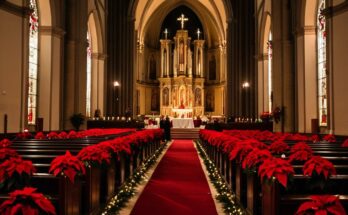
On Monday, November 9, 2026, the Church keeps the Feast of the Dedication of the Lateran Basilica. In the Ordinary Form this is a Feast of the Lord; in the 1962 Missal it is the Dedication of the Archbasilica of Our Holy Savior, a feast of the second class, with a commemoration of the martyr St. Theodore. Either way, it is a day to love the house of God and to remember that every parish church shares in this mystery of dedication.
Why This Church Matters
Many visitors to Rome assume that St. Peter’s is the Pope’s cathedral. It is not. The cathedral of the Bishop of Rome—the church that holds his cathedra, his teaching chair—is the Archbasilica of Saint John Lateran on the Lateran hill. The traditional inscription over its facade proclaims it omnium urbis et orbis ecclesiarum mater et caput: mother and head of all the churches of the City and of the world.
It was dedicated originally to Christ the Savior. In later centuries it came also to bear the titles of St. John the Baptist and St. John the Evangelist, which is why Catholics commonly call it St. John Lateran. The feast itself, however, keeps the older dedication: the house of Our Holy Savior, the mother church of Christendom.
A Brief History
In the early fourth century, after the peace of the Church under Constantine, the Emperor gave the Lateran palace to the Bishop of Rome. Beside it rose a great basilica, dedicated in that same century as the cathedral of the Popes. Fires, earthquakes, and the wear of ages forced repeated rebuilding, yet the Lateran never ceased to be the mother church. The present monumental facade, crowned with statues of Christ and the Apostles, was completed by Alessandro Galilei in 1735. Within, the papal throne still marks the cathedra of the Bishop of Rome, and nearby stands the ancient Lateran Baptistery, a reminder of the waters of regeneration that make us living stones of the Church.
What the Feast Teaches
This feast is not only about one building in Rome. It teaches what every consecrated church is, and what the Church herself is. St. Paul writes: “Know you not that you are the temple of God, and that the Spirit of God dwelleth in you? But if any man violate the temple of God, him shall God destroy. For the temple of God is holy, which you are” (1 Corinthians 3:16-17). The Catechism of the Catholic Church echoes this: the Church is “the living temple” built of living stones, and our visible churches are signs of that dwelling of God among men (CCC 756, 1197).
When Jacob awoke from his dream at Bethel he cried out, Terríbilis est locus iste—”How awesome is this place! This is none other than the house of God, and this is the gate of heaven” (Genesis 28:17). That verse has long been the Introit of the Mass for the dedication of a church. The Gospel often appointed for this feast in the Ordinary Form is Our Lord’s cleansing of the Temple (John 2:13-22), where zeal for His Father’s house consumes Him, and where He speaks of the temple of His own Body. The Old Testament lesson of water flowing from the temple (Ezekiel 47) points forward to the living waters of grace that flow from Christ and from His Church for the healing of the nations.

How to Keep the Feast on November 9, 2026
- Assist at Holy Mass if you can, offering the Sacrifice in thanksgiving for the cathedral of the Pope and for your own parish church.
- Pray for the Holy Father and for the Diocese of Rome, of which the Lateran is the cathedral.
- Visit your parish church, or if you cannot, pray for it—for its pastors, its people, and its faithful keeping as a house of God.
- Make a spiritual communion if you are unable to attend Mass, uniting yourself to the altar of the Church throughout the world.
- Pray Psalm 84 (83)—How lovely are Thy tabernacles, O Lord of hosts—or the traditional Introit Terríbilis est locus iste, remembering that every parish church shares in this mystery of dedication.
O God, who year by year renewest for us the day of the consecration of this Thy holy temple, and dost ever bring us again in safety to the sacred mysteries: hear the prayers of Thy people, and grant that whosoever entereth this temple to ask blessings of Thee may rejoice in obtaining all his petitions. Through our Lord Jesus Christ. Amen.