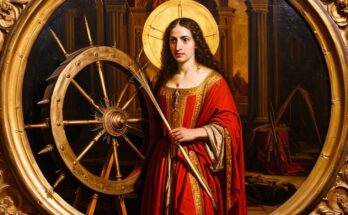
On November 22 the Church honors St. Cecilia, virgin and martyr, the patron saint of music and musicians. Choirs, organists, and DJs can all look to her, because a musician is a musician, whether the instrument is a pipe organ, a human voice, or a wedding dance floor. She is named in the Roman Canon of the Mass, and her relics rest in the basilica of Santa Cecilia in Trastevere in Rome. In 2026 her memorial fell on a Sunday, the Solemnity of Our Lord Jesus Christ, King of the Universe, so the Mass of Christ the King took precedence that day. Her story, and the reason musicians of every kind still claim her, is worth knowing any day of the year.
A Roman Virgin and Martyr
Cecilia is one of the most beloved virgin martyrs of the early Roman Church, and the veneration is very old. The Martyrology of St. Jerome shows that her feast was already being kept in Rome in the fourth century. By the year 499, a titular church in the Trastevere neighborhood was signing itself as the titulus sanctae Caeciliae. Pilgrim guides pointed out her grave in the Catacomb of Callistus, next to the crypt of the third-century popes. By the end of the fifth century, a Roman collection of Masses, the Leonine Sacramentary, contained no fewer than five different Masses in her honor. And to this day she is named in the Roman Canon (Eucharistic Prayer I), in the prayer Nobis quoque, alongside Felicity, Perpetua, Agatha, Lucy, Agnes, and Anastasia.
The year of her martyrdom is not known with certainty. After reviewing the theories, the 1911 Catholic Encyclopedia concludes that the position of her tomb allows a date from the end of the second century to the middle of the third.
The Acts of St. Cecilia
Most of what is told about her life comes from the Acts, or Passio, of St. Cecilia, written about the middle of the fifth century. The Church has long treasured this account. At the same time, as the Catholic Encyclopedia says plainly, “in this shape the whole story has no historical value; it is a pious romance, like so many others compiled in the fifth and sixth century.” The same article insists that the existence of these martyrs is a historical fact, and that the traditional bond between Cecilia, Valerian, Tiburtius, and Maximus may have some historical foundation.
According to the Acts:
- Cecilia was a Christian of a senatorial family and a virgin from her infancy. Her parents gave her in marriage to a noble pagan youth, Valerian.
- After the wedding she told him that an angel guarded her, and that her virginity was consecrated to God. If he wished to see the angel, he must first be baptized.
- She sent him to Pope Urban on the Via Appia. Valerian was baptized, returned a Christian, and an angel appeared and crowned the couple with roses and lilies. Valerian’s brother Tiburtius was also won to the Faith.
- The two brothers gave rich alms and buried the bodies of the martyrs. The prefect condemned them to death. Maximus, the officer sent to carry out the sentence, was himself converted and suffered martyrdom with them.
- Cecilia was then sought out. After a glorious confession of faith she was condemned to be suffocated in the bath of her own house. When she remained unhurt, the executioner was sent to behead her. He struck three times without severing her head, and fled. She lived three days, provided for the poor, and arranged that her house should be used as a church. Urban buried her in the Catacomb of Callistus.
Why Musicians — and DJs — Can Claim Her
The connection to music comes from a line in those Acts, later sung as an antiphon in the Divine Office: “Cantantibus organis, Caecilia virgo in corde suo soli Domino decantabat” — “While the instruments played, the virgin Cecilia sang in her heart to the Lord alone.”
The original scene is her wedding feast. While the music of the celebration played around her, her heart was singing to God. The Latin organis meant musical instruments in general, not specifically a pipe organ. Over time, especially once some liturgical texts left out the words in corde suo (“in her heart”), the line was easily heard as if Cecilia herself were singing, or even playing. From the fourteenth and fifteenth centuries, artists began to place an organ in her hands or at her side. In 1585 a congregation of Roman musicians was established under her patronage, the body that became the Accademia Nazionale di Santa Cecilia. In the nineteenth century the Cecilian movement worked to renew sacred music in the Church, encouraging Gregorian chant and sacred polyphony. The Catholic Encyclopedia already called her “patroness of church music.”
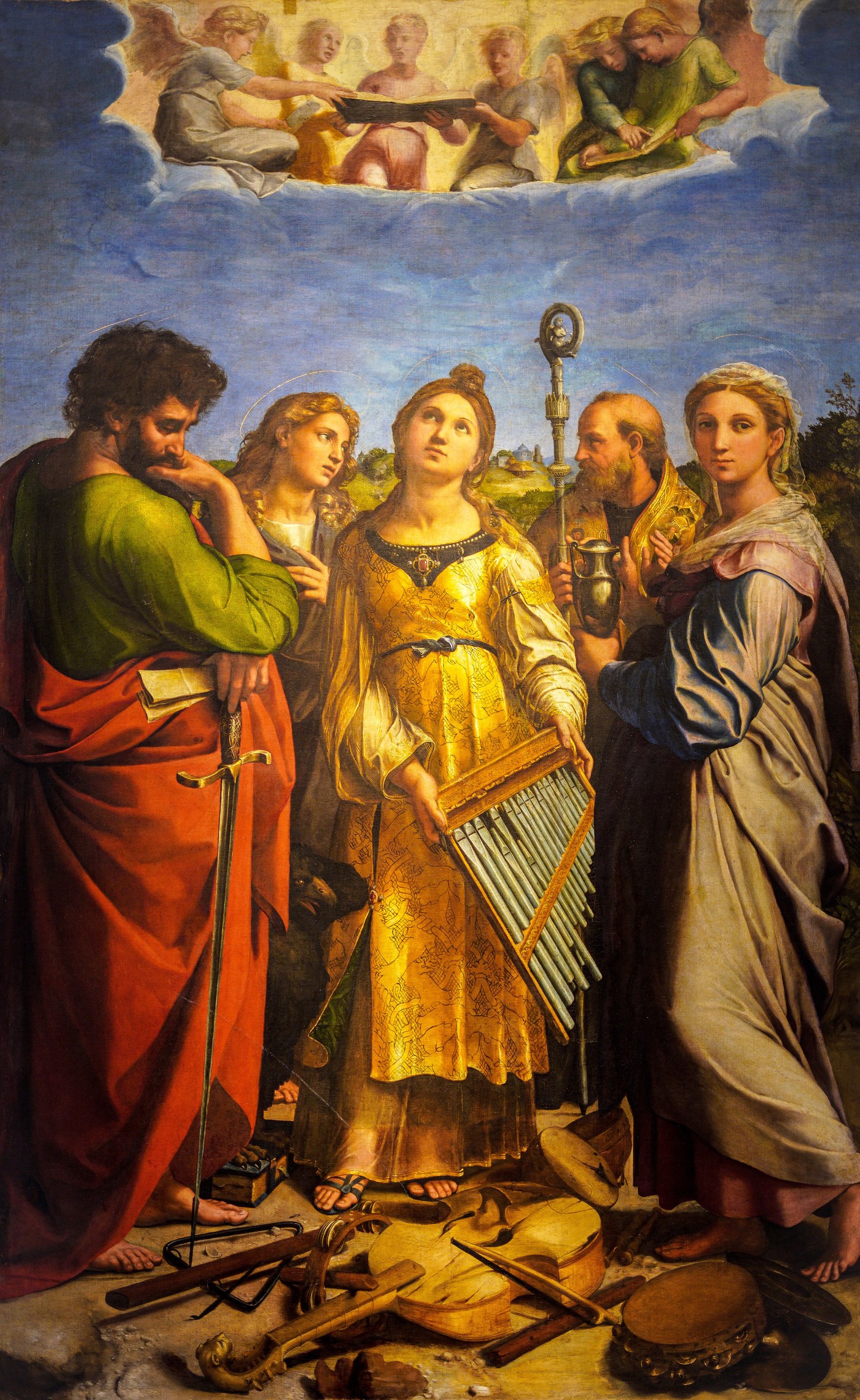
Raphael’s painting makes the meaning visible. Earthly instruments lie at her feet. She holds a portative organ, but her face is turned upward, listening to the choir of heaven.
There is a lesson in that origin, and it is the reason DJs can claim her too. St. Cecilia is not the patron of music because she performed. She is the patron of music because, in the middle of a wedding feast, her heart was turned entirely toward God. The Church has not issued a separate decree naming her “patron saint of DJs,” and none is needed. A DJ is a musician. The very scene that made Cecilia the patron of musicians is a wedding, with instruments playing for a celebration. Choirs, cantors, organists, composers, and the DJ who serves a wedding or a family feast all stand in the same patronage.
For Church Musicians, Choirs, and DJs
If you sing in a parish choir, play the organ, lead the music at Mass, or teach children their first hymns, St. Cecilia is your saint. Her feast is a good day to ask her prayers, to thank the musicians who serve your parish, and to remember that the most important song is the one sung to God in the heart.
The same is true of the musicians who serve at weddings and celebrations. Catholic couples preparing a reception, and families planning a feast, can ask St. Cecilia to watch over the music as she watched over her own wedding day. In Murrieta, Temecula, and the surrounding communities, DJ C-Zer and Company has provided music for weddings and celebrations for more than 10 years.
The Tomb Opened in 1599
In the ninth century, Pope Paschal I (817–824) rebuilt the church of Santa Cecilia in Trastevere and set out to translate her relics there. According to the traditional account, he could not at first find them and feared the Lombards had stolen them. Cecilia appeared to him in a vision and told him to keep searching; he had already been very near her grave. He then found her body in the Catacomb of Praetextatus, dressed in cloth of gold, and brought her relics, with those of Valerian, Tiburtius, and Maximus, to rest under the high altar of the basilica.
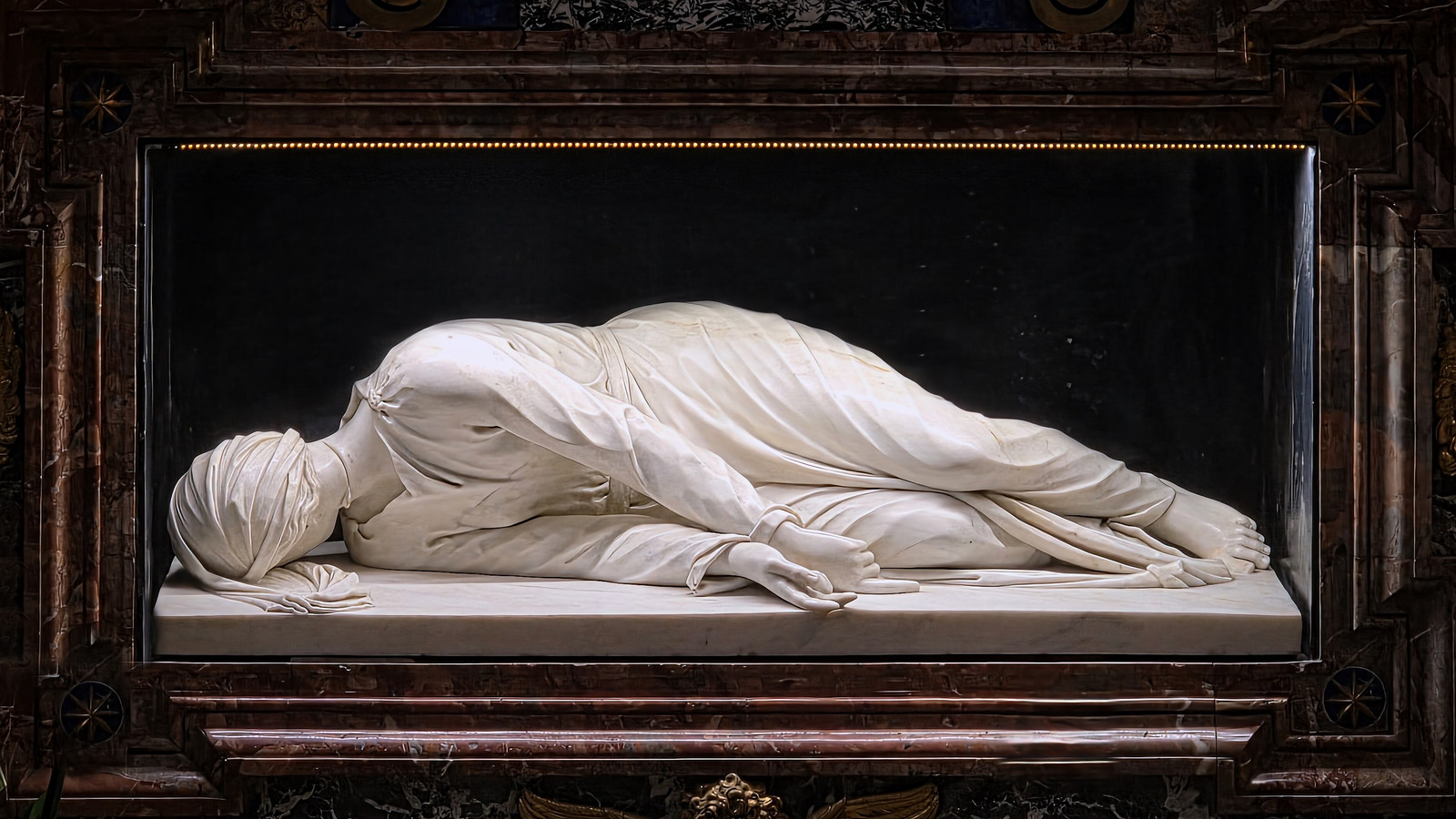
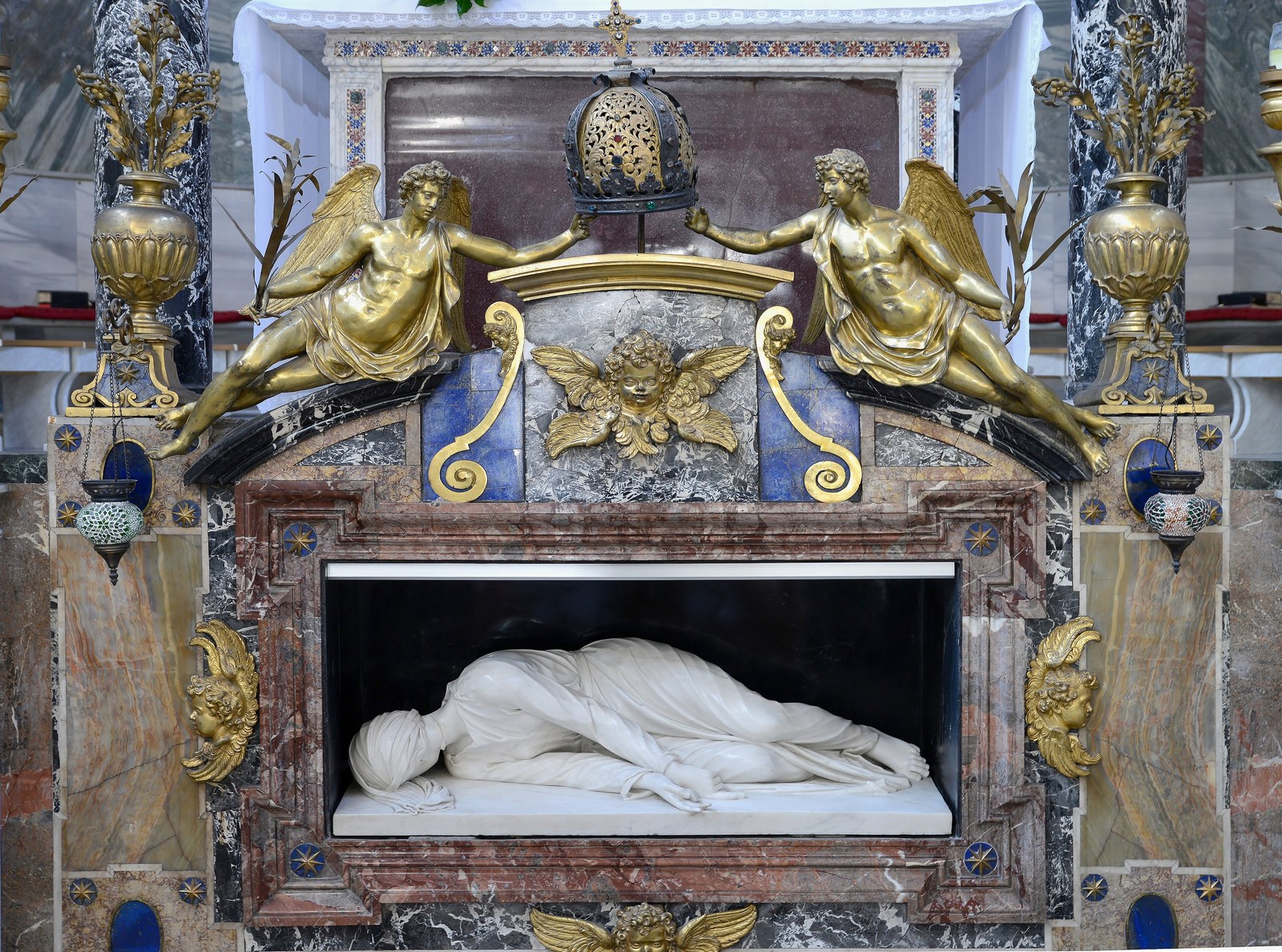
In 1599, during a restoration of the church, Cardinal Paolo Emilio Sfondrati had the tomb under the altar opened and found the sarcophagi that Paschal had placed there. Accounts of that opening, and the inscription the cardinal had carved, say that he saw Cecilia lying intact in the tomb, and that he commissioned the young sculptor Stefano Maderno to represent her in exactly that position. The marble statue still lies beneath the high altar: on her side, face turned down, a wound visible in her neck, her fingers often read as a last confession of the Trinity. It remains one of the most moving images of martyrdom in Christian art.
How to Keep the Feast
- Assist at Holy Mass on her memorial when it is celebrated. In 2026, November 22 was the Solemnity of Christ the King, which took precedence; you can still honor her in your prayers any day.
- Pray the traditional Collect given below, and the short prayer for musicians that follows it.
- Thank your parish musicians. Write a note to your organist, cantor, or choir director. Their ministry is often hidden and rarely thanked.
- Pray for all who make music for the worship of God, and for those who provide music at weddings and celebrations.
- Sing at Mass. You do not need a great voice. St. Augustine is often credited with saying that whoever sings prays twice.
- Listen to sacred music at home. Gregorian chant, which the Second Vatican Council called “specially suited to the Roman liturgy,” is a beautiful place to start. You can also tune in to Walsingham Radio.
- Teach children her story, then let them sing a hymn they love.
- Make an act of interior prayer, like Cecilia, in the middle of a busy or noisy day: a quiet “Lord, I love you” in the midst of the music of life.
A Prayer to St. Cecilia
O God, who dost gladden us with the yearly festival of blessed Cecilia, Thy virgin and martyr, grant that we may follow the example of her pious life, whom we honor in this office. Through our Lord Jesus Christ, Thy Son, who liveth and reigneth with Thee in the unity of the Holy Ghost, God, world without end. Amen.
From the traditional Roman Missal, November 22.
St. Cecilia, faithful virgin and martyr, you sang in your heart to the Lord alone, even while the instruments of a wedding played around you. Pray for all who make music for the worship of God, and for all who bring music to weddings and celebrations, that their song may lift hearts to heaven. Help us to keep our hearts turned toward Jesus in every noise of the day, and to praise Him with our lives as you did. Amen.
St. Cecilia, virgin and martyr, patroness of musicians, pray for us. Stay with us here at Walsingham Radio, founded by Cesar Ramirez, for more traditional Catholic programming and sacred music. Tomorrow the Church honors St. Catherine of Alexandria, and Advent begins on Sunday, November 29.