On Wednesday, November 11, 2026, the Church honors St. Martin of Tours, bishop and confessor: the Roman soldier who cut his cloak in two for a beggar, the monk who brought the monastic life to Gaul, and the bishop whose tomb became one of the great pilgrim shrines of Christendom. In the traditional calendar of the 1962 Missal his feast is kept with a commemoration of St. Mennas, an Egyptian soldier-martyr, so that this day honors two soldiers of Christ at once. For many centuries Martinmas was one of the most beloved holy days of the Christian year.
The Soldier at the Gate of Amiens
Martin was born around the year 316 at Sabaria in Pannonia, in present-day Hungary, the son of a pagan officer of the Roman army. He grew up in Pavia in northern Italy and, against his parents’ wishes, asked to be enrolled as a catechumen while still a boy. As the son of a veteran he was obliged by law to serve in the army, and so at about fifteen he was made a cavalryman.
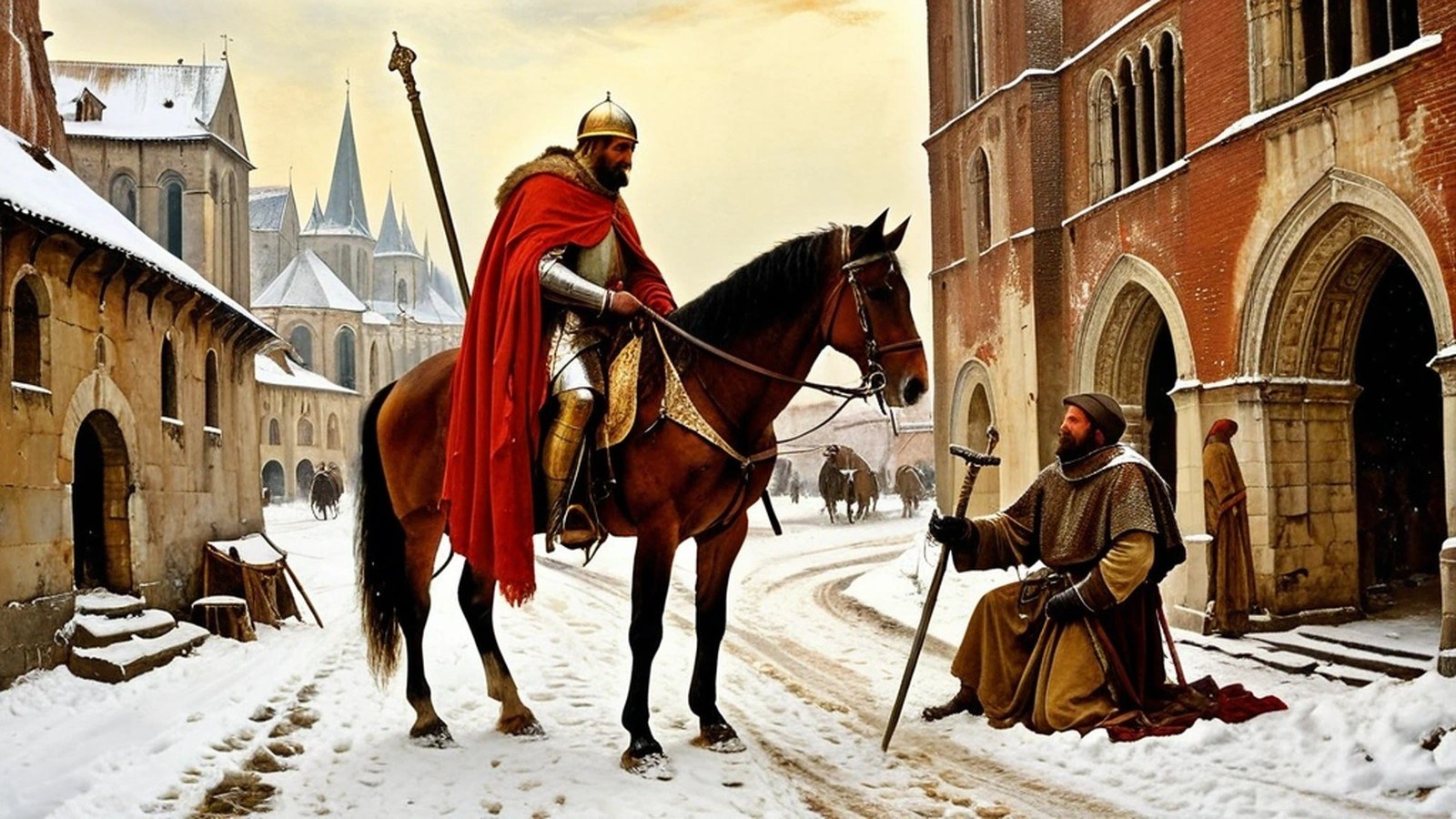
The scene that made him famous took place in a winter so severe that men were dying of cold. At the gate of Amiens, Martin met a poor man with hardly any clothing, whom everyone else passed by. Martin had already given away everything but his arms and his military cloak. So he drew his sword, cut the cloak in two, gave half to the beggar, and wrapped himself in what was left, while some of the bystanders laughed at the strange figure he made. That night Our Lord appeared to him in a dream, clothed in the half-cloak, and said to the angels around Him, in the words recorded by his biographer, “Martin, who is still but a catechumen, clothed me with this robe” (Sulpicius Severus, Life of St. Martin, ch. 3, via New Advent).
Martin had simply taken the Gospel at its word: “Amen I say to you, as long as you did it to one of these my least brethren, you did it to me” (Matthew 25:40, Douay-Rheims). The Catechism lists clothing the naked among the corporal works of mercy, the “charitable actions by which we come to the aid of our neighbor in his spiritual and bodily necessities” (CCC 2447). Soon after the vision, Martin was baptized.
A Soldier of Christ
Some time later, as the army prepared for battle, Martin asked to be released from service, telling the Caesar Julian that he was now a soldier of Christ. When he was accused of cowardice, he offered to stand unarmed in front of the battle line, protected only by the sign of the Cross. The next day the enemy sued for peace, and Martin was discharged. He went to Poitiers, to the great bishop St. Hilary, the defender of the divinity of Christ against the Arians, and became his disciple.
Around 361, with Hilary’s blessing, Martin founded a community of hermits at Ligugé, near Poitiers, one of the first monasteries in Gaul. Its successor, the Abbey of St. Martin of Ligugé, still stands today.
Bishop of Tours and Father of Monks
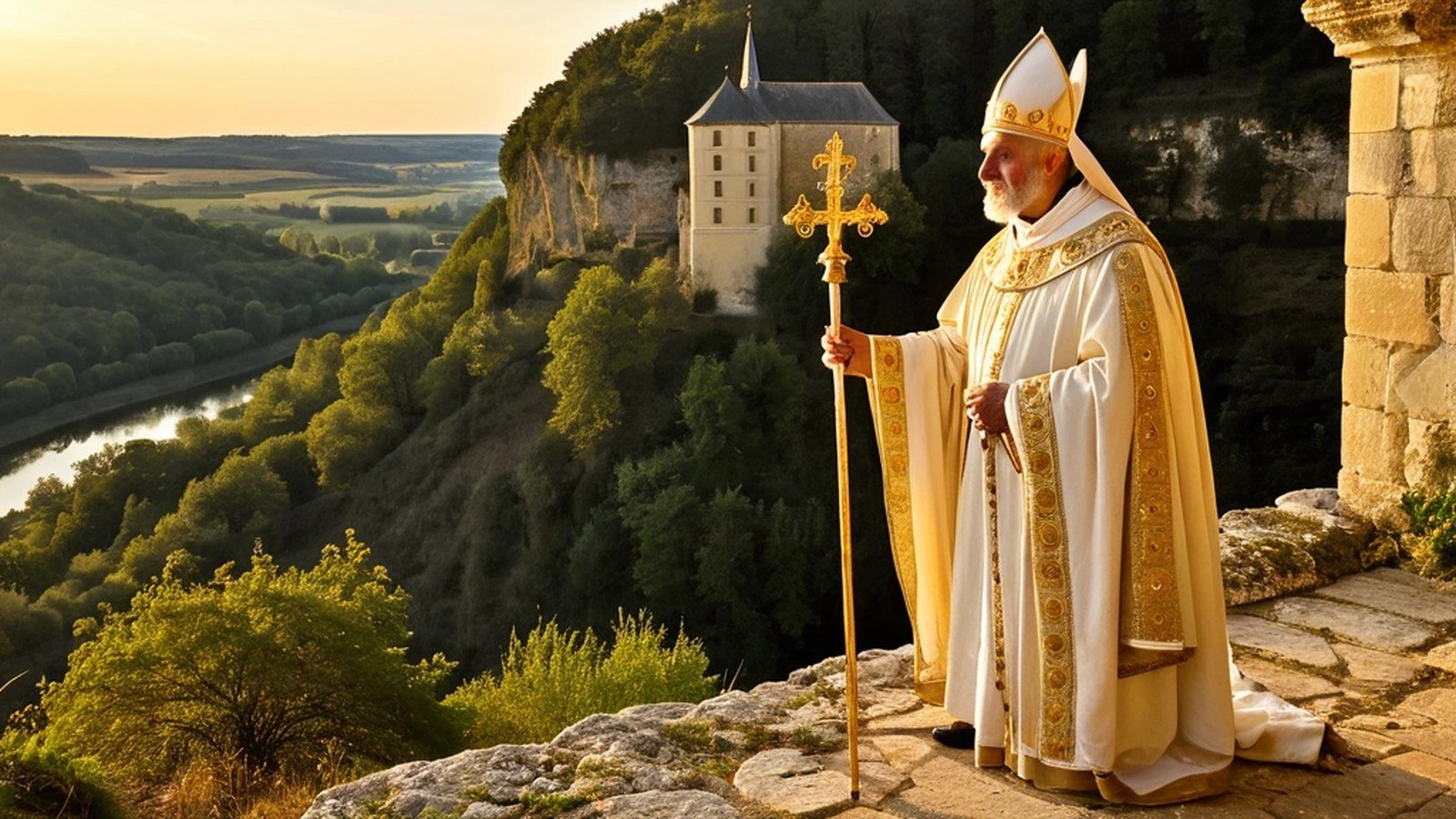
In 371 the people of Tours wanted Martin as their bishop. According to a well-loved legend, he hid in a barn to escape the honor, and the honking of geese gave him away, which is one reason the Martinmas goose came to the table. Some of the bishops present objected that this unkempt monk in rough clothing was unfit for the office. The people would hear of no one else.
As bishop, Martin refused to stop being a monk. Outside the city, against the cliffs beside the Loire, he founded Marmoutier, where he and some eighty disciples lived in caves and wooden cells, in poverty, prayer, and silence. From there he traveled the countryside of Gaul, then still largely pagan, preaching, destroying idol shrines, founding rural parishes, and healing the sick. He was firm in the faith yet merciful to heretics: he pleaded with the Emperor that the Priscillianists not be put to death, holding that error should be overcome by preaching, not by the sword.
He died at Candes on November 8, 397, lying on ashes in a hair shirt. His last prayer is one of the most beautiful in Christian tradition: Domine, si adhuc populo tuo sum necessarius, non recuso laborem—”Lord, if I am still needed by Thy people, I do not refuse the labor; Thy will be done.” He was buried at Tours on November 11, and that day became his feast.
One of the First Confessors
For the first centuries, the saints the Church honored publicly were almost all martyrs. Martin was among the very first non-martyrs to receive a public cult in the West, honored as a confessor: one who bore witness to Christ by a holy life rather than by a violent death. His disciple Sulpicius Severus wrote his Life while Martin was still alive, and it became one of the most widely read books of the early Middle Ages. It remains our main source for his life.
Even our everyday Catholic vocabulary carries his memory. The Frankish kings kept the half of Martin’s cloak, the cappa, as a treasured relic, carried it into battle, and had oaths sworn on it. The priests who looked after it were called cappellani, and the shrine where it was kept was the capella. From these come our words chaplain and chapel. Every military chaplain and every little chapel is, in a sense, named after St. Martin’s cloak.
Martinmas and St. Martin’s Lent
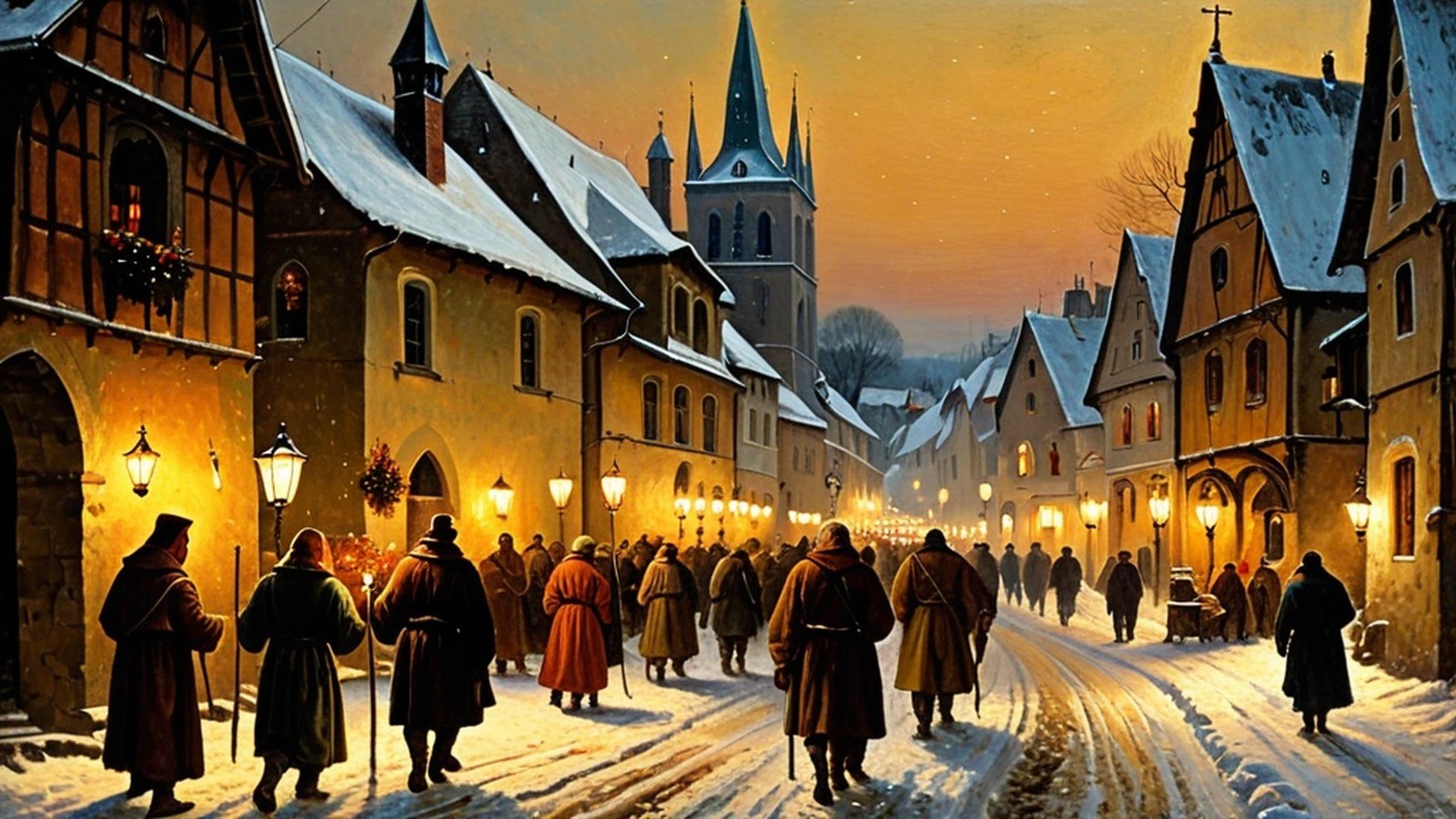
In Catholic Europe, November 11 was a great day of feasting and a turning point in the year. The harvest was in, the new wine was tasted, and accounts and rents were settled. The goose was roasted, and the mild spell of weather that often comes in early November was called “St. Martin’s summer.” In Germany, the Low Countries, and elsewhere, children still carry lanterns through the streets on St. Martin’s Eve, singing songs to the saint, often behind a rider in a red cloak on a white horse.
The feast was also a doorway into penance. From the fifth century in Gaul, the days between St. Martin’s and Christmas were kept as a season of fasting called Quadragesima Sancti Martini, “St. Martin’s Lent.” The Council of Mâcon in 581 directed that Monday, Wednesday, and Friday be kept as fast days from St. Martin’s Day until the Nativity. This forty-day preparation is one of the roots of our season of Advent. Martinmas was the last feast before the fast, much as Shrove Tuesday comes before Lent.
Patron of Soldiers on Veterans Day
It is fitting that in the United States November 11 is also Veterans Day, which began as Armistice Day, marking the end of the First World War on the eleventh hour of the eleventh day of the eleventh month of 1918, on St. Martin’s own feast. Martin is a patron of soldiers, of the cavalry, of France, and of the poor. On this day we may ask his prayers for all who have served, for those still carrying the wounds of war, for military chaplains, and for the souls of the fallen.
How to Keep the Feast on November 11, 2026
- Assist at Holy Mass if you can, and pray for the veterans in your family and parish.
- Clothe the naked. Donate a warm coat, blanket, or gloves to a shelter or St. Vincent de Paul conference, as winter comes on.
- Keep a Martinmas table. Roast goose or chicken, a glass of new wine, and a word to the children about the saint who shared his cloak.
- Walk with lanterns. Families with small children can make simple paper lanterns and process around the house or yard singing a hymn.
- Consider St. Martin’s Lent. Choose a small Advent fast, such as on Wednesdays and Fridays, beginning now and continuing until Christmas.
Prayer to St. Martin
Collect for the Feast of St. Martin (Roman Missal, traditional)
Deus, qui conspicis, quia ex nulla nostra virtute subsistimus: concede propitius; ut, intercessione beati Martini Confessoris tui atque Pontificis, contra omnia adversa muniamur. Per Dominum nostrum.
O God, who seest that we subsist by no strength of our own: mercifully grant that, by the intercession of blessed Martin, Thy Confessor and Bishop, we may be defended against all adversities. Through our Lord Jesus Christ, Thy Son, who liveth and reigneth with Thee in the unity of the Holy Ghost, God, world without end. Amen.
St. Martin of Tours, soldier of Christ, pray for us.