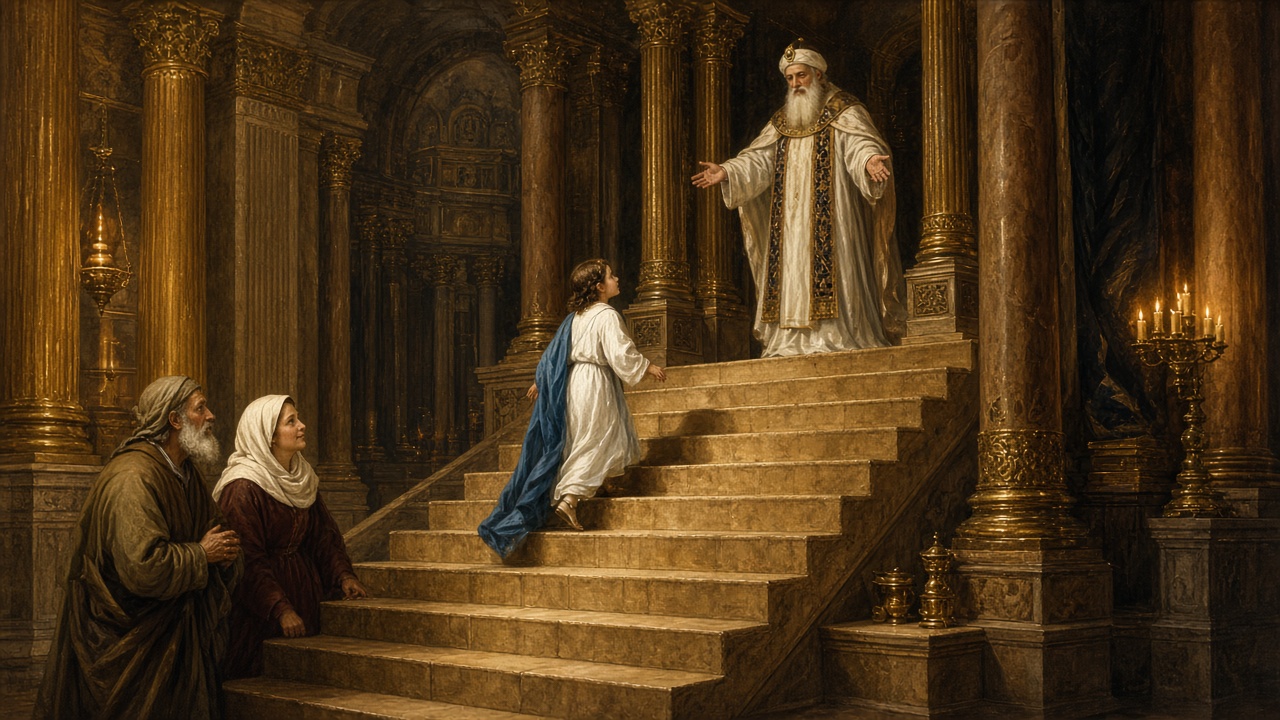
On Saturday, November 21, 2026, the Church keeps the feast of the Presentation of the Blessed Virgin Mary, the day tradition remembers the little Mary being brought by her parents, St. Joachim and St. Anne, to the Temple in Jerusalem and offered wholly to God. In the traditional calendar of the 1962 Missal it is a third-class feast, and in the current Roman calendar it is an obligatory memorial, so Catholics of both forms of the Roman Rite honor Our Lady together on this day. It is a quiet feast, with no great crowds or processions, yet it speaks of something at the very heart of the Christian life: a soul that belongs entirely to God from its earliest years.
What the Ancient Tradition Tells Us
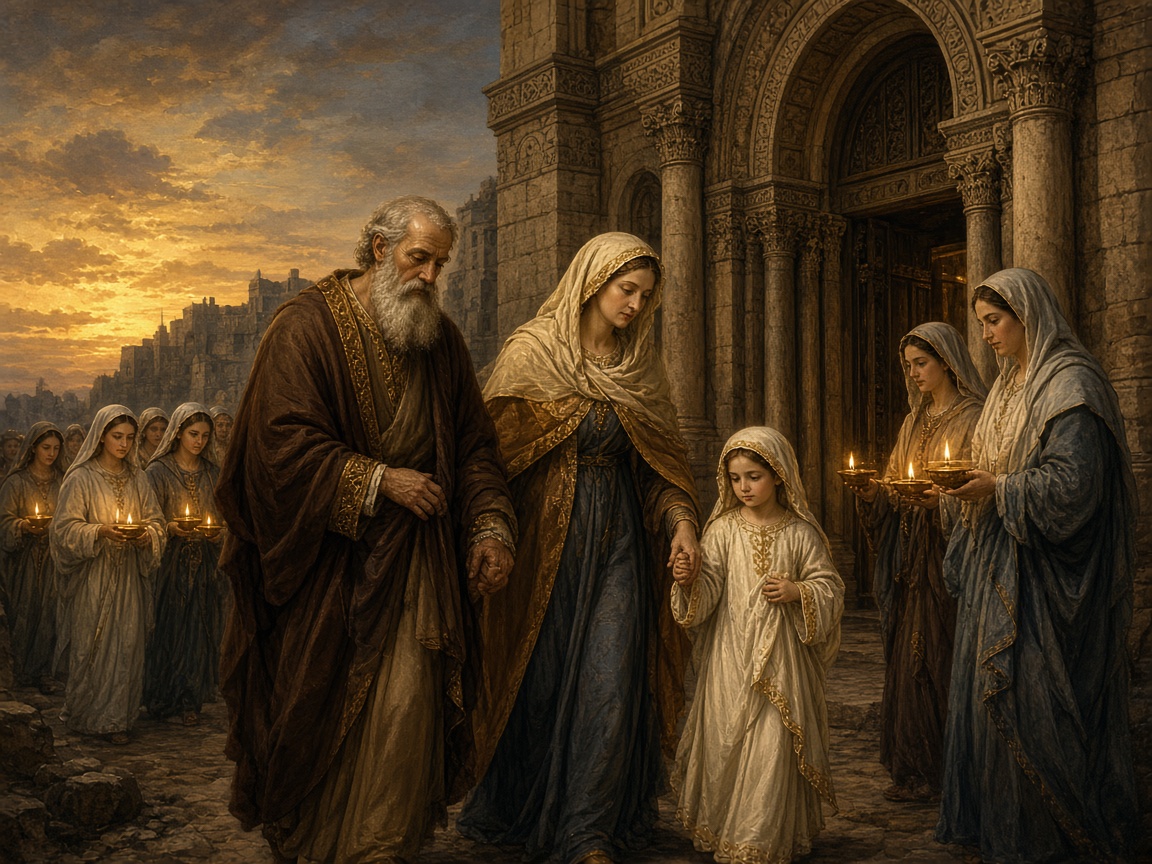
The Gospels say nothing of Mary’s childhood. The story of her presentation comes to us from the Protoevangelium of James, a second-century writing that the Church never received into Scripture, but whose account of Mary’s parents and early years shaped Christian devotion and art for centuries. It relates that Joachim and Anne, long childless, vowed that if God gave them a child they would dedicate it to His service. When Mary was three years old, they brought her to the Temple, accompanied by young girls carrying lamps so that the child would not look back. The priest received her and set her on the third step of the altar, and the Lord gave grace to the child, who danced with joy, “and all the house of Israel loved her.” The story adds that she lived in the Temple and was fed by the hand of an angel.
The 1911 Catholic Encyclopedia notes that this and other apocryphal writings relate that Mary “at the age of three, was brought by her parents to the Temple, in fulfillment of a vow, there to be educated.” The Church does not ask us to accept every detail of these old narratives as history. What she does celebrate is the truth beneath them: that Mary, preserved from all sin from the first moment of her conception, gave herself to God completely and without reserve.
From the East to Rome
Like many Marian feasts, the Presentation began in the East. Historians commonly connect it with the dedication of the New Church of St. Mary in Jerusalem in the sixth century, and by the eleventh century it was firmly established in the Byzantine calendar. To this day the Eastern Churches count the Entry of the Most Holy Theotokos into the Temple among their twelve Great Feasts.
In the West the feast arrived late. According to the Catholic Encyclopedia, a French nobleman, Philippe de Mézières, chancellor of the King of Cyprus, brought it to the papal court at Avignon, where it was celebrated before the cardinals in 1372 under Pope Gregory XI. It spread to Paris, Metz, and Cologne; Pope Sixtus IV received it into the Roman Breviary; St. Pius V removed it in his reform; and Pope Sixtus V restored it to the universal calendar in 1585, where it has remained ever since.
The Mass of the Feast
In the traditional Roman Missal the feast takes the Mass Salve, sancta Parens, the beloved Introit of Our Lady: “Hail, holy Mother, who didst bring forth the King who rules heaven and earth for ever and ever.” The Epistle, from Ecclesiasticus 24, speaks of Wisdom ministering before God “in the holy dwelling place” and being established in Sion, words the Church has long applied to Mary, the living Temple in whom the Word would dwell. The Gospel (Luke 11:27-28) records the woman who cried out, “Blessed is the womb that bore thee,” and Our Lord’s answer: “Yea rather, blessed are they who hear the word of God, and keep it.” Mary is blessed above all because she heard the word of God and kept it most perfectly of all.
The verses of Psalm 44 that the Church so often sings for holy virgins could have been written for this day: “Hearken, O daughter, and see, and incline thy ear: and forget thy people and thy father’s house. And the king shall greatly desire thy beauty” (Psalm 44:11-12, Douay-Rheims).
Why This Feast Matters
The Presentation looks forward to the Annunciation. The child who was offered in the Temple is the same young woman who would answer the angel, “Behold the handmaid of the Lord; be it done to me according to thy word” (Luke 1:38). The Catechism teaches that Mary was “enriched from the first instant of her conception with the splendor of an entirely unique holiness” and that “by the grace of God Mary remained free of every personal sin her whole life long” (CCC 492-493). Her presentation is the first visible sign of that total belonging. As St. Paul reminds every Christian, “Know you not, that you are the temple of God, and that the Spirit of God dwelleth in you?” (1 Corinthians 3:16). Mary shows us what such a temple looks like when nothing is held back.
Pro Orantibus: A Day for Those Who Pray for Us
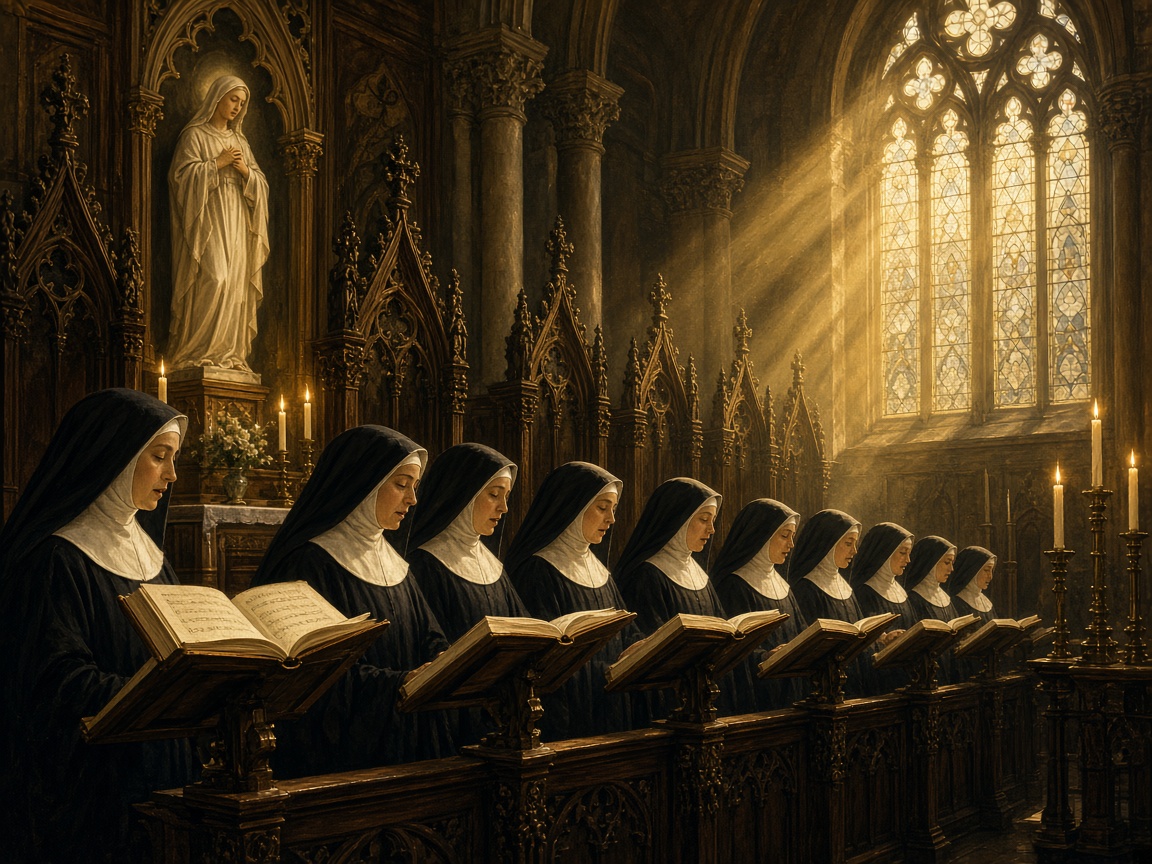
Because the young Mary was given over to a life of prayer in the house of God, the Church has also made November 21 a day to remember cloistered contemplative religious. Pope Pius XII instituted this Pro Orantibus (“for those who pray”) Day in 1953. Hidden behind monastery walls, Carmelites, Poor Clares, Benedictines, and many others chant the Divine Office day and night for the Church and the world. This is a fitting day to thank God for them, to pray for vocations to the contemplative life, and perhaps to send a note or an offering to a monastery near you.
A Weekend of Feasts
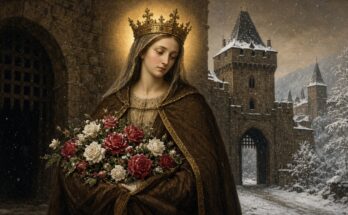
This year the Presentation opens a remarkable weekend. On Sunday, November 22, the Church honors St. Cecilia, virgin and martyr and patroness of sacred music, and in the Ordinary Form that Sunday is also the Solemnity of Our Lord Jesus Christ, King of the Universe, the last Sunday of the liturgical year before Advent begins on November 29. It is fitting that the Queen should be honored on the eve of her Son’s kingship.
How to Keep the Feast
- Assist at Holy Mass on Saturday morning if you can, or pray the Collect of the feast at home.
- Renew your own consecration to God through Mary, perhaps with the prayer of St. Louis de Montfort or a simple act of offering.
- Pray for cloistered nuns and monks and for vocations, especially to the contemplative life.
- Offer your children to God: parents may follow the example of Joachim and Anne by blessing their children and entrusting them to Our Lady.
- Pray the Joyful Mysteries of the Rosary, remembering that the girl in the Temple became the Mother of God.
The Collect of the Feast
O God, who didst will that blessed Mary ever Virgin, the dwelling place of the Holy Ghost, should be presented this day in the temple: grant, we beseech Thee, that through her intercession we may be found worthy to be presented in the temple of Thy glory. Through Our Lord Jesus Christ, Thy Son, who liveth and reigneth with Thee in the unity of the same Holy Ghost, God, world without end. Amen.
From the traditional Roman Missal, November 21.
Holy Mary, presented in the Temple and given wholly to God, pray for us, and pray for all who pray for the Church in silence. Stay with us here at Walsingham Radio for more traditional Catholic programming and devotions as we close the liturgical year and prepare for Advent.