Short answer: St. Cecilia was a young Roman Christian woman martyred in the early centuries of the Church, honored on November 22 and named in the Roman Canon of the Mass. She became the patron saint of music because of a line from the ancient account of her life: on her wedding day, while the instruments played, “Cecilia sang in her heart to the Lord alone.” Choirs, organists and musicians around the world still celebrate her feast, and her story is a beautiful reminder that the most important song is the one sung to God in the heart.
For a Catholic radio station, there are few saints closer to home than St. Cecilia. Every hymn, chant and sacred song we share is, in its own way, an echo of hers.
Who was St. Cecilia?
Cecilia is one of the most beloved virgin martyrs of the early Roman Church. Historians agree that she was venerated very early in Rome, that a church in the Trastevere neighborhood bears her name, and that she is among the women saints named in the Roman Canon (Eucharistic Prayer I), alongside Felicity, Perpetua, Agatha, Lucy, Agnes and Anastasia.
Most of what is told about her life comes from a later account, the Passio (Acts) of St. Cecilia, written around the fifth century. The Church has long treasured this story while recognizing that some of its details are legendary. According to the traditional account:
- Cecilia was a Christian of a noble Roman family who had consecrated her virginity to God.
- She was given in marriage to a young pagan named Valerian. On their wedding night she told him that an angel guarded her, and that he could see the angel if he were baptized.
- Valerian was baptized, and his brother Tiburtius also came to faith. Both were later martyred for burying Christian dead and refusing to sacrifice to the gods.
- Cecilia was arrested for her faith. The executioner struck her three times but could not sever her head, and she lived for three days, encouraging the faithful and giving her goods to the poor, before she died.
Why is she the patron saint of music?
The connection comes from an antiphon based on her Passio, sung for centuries in the Divine Office: “Cantantibus organis, Caecilia in corde suo soli Domino decantabat”, “While the instruments played, Cecilia sang in her heart to the Lord alone.”
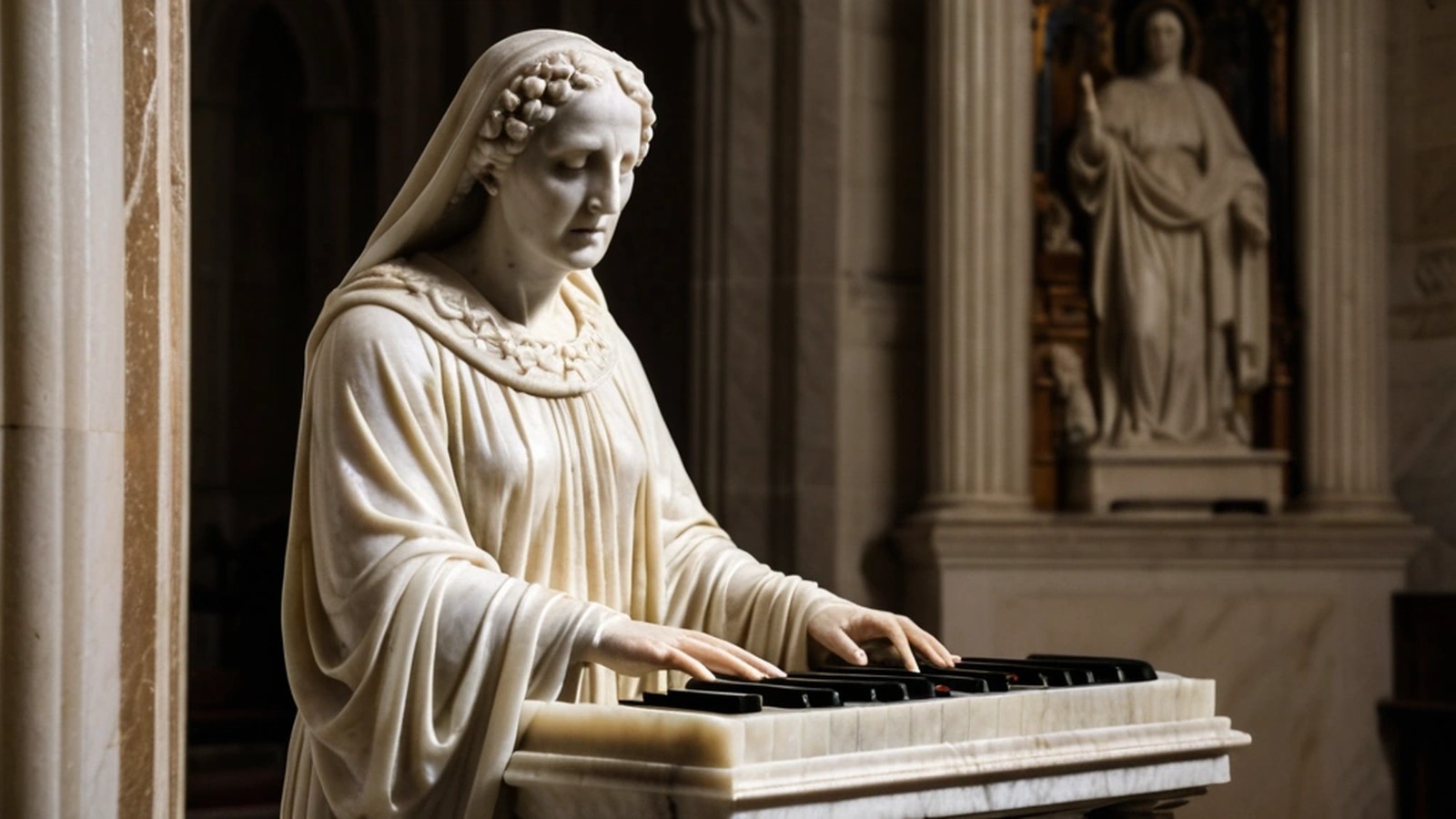
The original meaning is about her wedding feast. While the music of the celebration played around her, Cecilia’s heart was singing to God. Over time, artists began to picture her with an organ or other instruments, and musicians adopted her as their patron. In 1585, the music academy in Rome now known as the Accademia Nazionale di Santa Cecilia was founded under her patronage, and in the nineteenth century the “Cecilian movement” worked to renew sacred music in the Church, encouraging chant and sacred polyphony.
There’s a lesson in that origin. St. Cecilia isn’t the patron of music because she performed. She is the patron of music because her heart was turned entirely toward God, even in the middle of a noisy feast. That’s the heart of all true sacred music.
The tomb opened in 1599
St. Cecilia’s relics were moved to the church of Santa Cecilia in Trastevere in the ninth century under Pope Paschal I. In 1599, during a restoration of the church, Cardinal Paolo Emilio Sfondrati had her tomb opened. Witnesses reported that her body was found remarkably preserved, lying on its side.
The sculptor Stefano Maderno carved a marble statue showing her as she was described at that moment: lying on her side, face turned away, with a visible wound on her neck. The statue still lies beneath the high altar of Santa Cecilia in Trastevere, and it remains one of the most moving images of martyrdom in Christian art.
St. Cecilia’s feast in 2026
St. Cecilia’s memorial falls on November 22. In 2026, November 22 is a Sunday, the Solemnity of Our Lord Jesus Christ, King of the Universe, so the Mass of Christ the King takes precedence that day. Many parish choirs and music ministries still mark St. Cecilia’s day around that weekend with a blessing, a prayer or a gathering, and you can honor her in your own prayer anytime during the week. If you’d like to prepare for that Sunday, our guide to the Feast of Christ the King explains its history and the indulgence attached to it.
Ways to honor St. Cecilia this November
- Thank your parish musicians. Write a note to your organist, cantor or choir director. Their ministry is often hidden and rarely thanked.
- Pray for those who make sacred music, from cathedral choirs to the volunteer who plays guitar at the early Mass.
- Sing at Mass. You don’t need a great voice. St. Augustine is often credited with saying that whoever sings prays twice.
- Listen to sacred music at home. Gregorian chant, which the Second Vatican Council called “specially suited to the Roman liturgy,” is a beautiful place to start.
- Teach children about her with a simple story at bedtime, then let them sing a hymn they love.
- Make an act of interior prayer, like Cecilia, during a busy or noisy day: a quiet “Lord, I love you” in the middle of the music of life.
A prayer to St. Cecilia
St. Cecilia, faithful virgin and martyr, you sang in your heart to the Lord alone, even in the midst of the world’s music. Pray for all who make music for the worship of God, that their song may lift hearts to heaven. Help us to keep our hearts turned toward Jesus in every noise and distraction of the day, and to praise Him with our lives as you did. Amen.
Frequently asked questions
When is St. Cecilia’s feast day? November 22. In 2026 it falls on a Sunday, when the Solemnity of Christ the King is celebrated instead.
Why is St. Cecilia the patron saint of music? Because of a line from the account of her life: while the instruments played at her wedding, she sang in her heart to God alone. Musicians later adopted her as their patron.
Is St. Cecilia mentioned at Mass? Yes. She is named in the Roman Canon (Eucharistic Prayer I), among the early martyrs the Church remembers.
Where is St. Cecilia buried? Her relics rest in the Basilica of Santa Cecilia in Trastevere in Rome, beneath Stefano Maderno’s famous statue.
Let your heart sing with Walsingham Radio
Walsingham Radio was founded by Cesar Ramirez to share the truth of the Catholic Faith with clarity, compassion and conviction. On St. Cecilia’s day and every day, tune in to our streams and let sacred music and prayer turn your heart toward the Lord, the way St. Cecilia’s did.